Updated July 2026
I saw a dog walker out at midday recently.
The temperature was already around 27 degrees.
My first thought was not, “I wonder how many minutes that dog has been out?”
It was simply, “Why is that dog being walked now?”
I am not interested in naming and shaming another dog walker.
I did not know the dog.
I did not know the full situation.
But it did make me think about a question I get asked every summer.
How hot is too hot to walk your dog?
The honest answer is frustrating.
There is no single magic temperature.
I cannot tell you that 21°C is completely safe and 22°C is suddenly dangerous.
Dogs are individuals.
A young, healthy dog walking slowly through shaded woodland may cope very differently from an older dog walking along a sunny pavement.
A French Bulldog is not a Labrador.
A senior rescue dog is not a fit young Spaniel.
And even the same dog may cope differently depending on humidity, health, fitness and how much exercise they have already had.
But that does not mean we should ignore the temperature.
It means we need to stop looking for one number and start looking at the whole dog.
My simple rule?
If you are asking yourself whether it may be too hot to walk your dog, slow down and think before clipping on the lead.
Your dog will survive missing a walk.
Heatstroke can kill.
For the bigger picture on heat, pavements, summer risks and vulnerable dogs, read my Summer Dog Safety Guide.
Some links on this page may be affiliate links. If you buy through them, I may earn a small commission at no extra cost to you. I only recommend products that fit the practical advice on this page.
Table of contents
- The quick answer: when is it too hot to walk a dog?
- There is no universal safe temperature for every dog
- Why exercise makes such a difference
- Which dogs are more at risk in hot weather?
- Humidity matters too
- Early morning is often better than waiting until late evening
- Check the pavement before walking your dog
- But my dog is asking for a walk
- What I do instead of a normal walk
- The few hot-weather products I actually find useful
- Signs your dog may be getting too hot
- What about wet towels and cooling bandanas?
- What I do as a professional dog walker during hot weather
- So, how hot is too hot to walk your dog?
- Frequently asked questions
- Is 20°C ok to walk my dog?
- Is 25°C too hot to walk a dog?
- Can I walk my dog at 8 pm during a heatwave?
- Does shade make a dog walk safe?
- Is it safe to walk a dog if I carry water?
- Do dogs need a walk every day during a heatwave?
- Which dogs struggle most in hot weather?
- What should I do if my dog is showing signs of heatstroke?
- Disclaimer
The quick answer: when is it too hot to walk a dog?
Here is my practical approach as a professional dog walker.
This is not a veterinary temperature chart.
It is how I start thinking about walks.
Below 18°C
For many healthy dogs, normal walks may still be manageable.
But I still consider:
- direct sunlight
- humidity
- the dog’s age
- breed or type
- fitness
- health
- coat
- the route
- how intense the exercise will be
A dog running after a ball for thirty minutes creates far more body heat than a dog slowly sniffing along a shaded path.
The number on your weather app is only part of the picture.
Around 18°C to 20°C
This is where I start paying closer attention.
Some dogs will be absolutely fine.
Others may already struggle.
I am particularly cautious with:
- flat-faced dogs
- older dogs
- overweight dogs
- puppies
- dogs with heart or breathing problems
- dogs with heavy coats
- unfit dogs
- dogs who have struggled with heat before
I also start thinking more carefully about the route.
Is there shade?
Are we walking across open pavements?
Is the dog likely to pull?
Will they become overexcited?
Does this dog normally run everywhere?
The dog matters more than the number.
Around 20°C to 23°C
Now I am thinking about adapting the walk.
That may mean:
- going out earlier
- reducing the distance
- slowing the pace
- choosing a shaded route
- allowing more sniffing
- avoiding open fields
- avoiding ball throwing
- carrying water
- stopping sooner
For some dogs, I may decide that a normal walk is not sensible.
This is particularly true if the humidity is high or there is strong direct sunlight.
Please do not think a dog has to look seriously ill before you change the plan.
I would rather shorten a walk while the dog still looks comfortable.
Around 23°C to 25°C
I become very cautious.
I am no longer asking, “Can I still complete the normal walk?”
I am asking, “Does this dog actually need this walk?”
Those are two very different questions.
Perhaps the dog needs a short toilet break.
Perhaps they need ten quiet minutes outside before returning home.
Perhaps the walk needs to happen very early in the morning.
Or perhaps the safest option is to skip the walk completely.
The Royal Kennel Club says that while many dogs may be comfortable between 15°C and 25°C, this depends heavily on age, breed, size, coat, health, fitness and exercise.
You can read the Royal Kennel Club advice on walking dogs on warm days.
I would never take 25°C to mean every dog is safe until that point.
Some dogs struggle at much lower temperatures.
25°C and above
Personally, I stop thinking in terms of a normal dog walk.
Could a dog potentially walk outside at 25°C?
Yes.
That does not mean a full walk is a sensible idea.
A dog may need to go outside to go to the toilet.
You may have a shaded garden.
You may be able to take them outside for a very brief time.
But I would not be trying to complete the usual distance because “they always have an hour”.
This is where expectations need to change.
A booked sixty-minute walk does not mean a dog must physically walk for sixty minutes regardless of the weather.
My Extreme Weather Policy allows me to shorten, adapt or replace walks when conditions are unsuitable.
I would much rather explain why your dog did not get their normal walk than explain why I ignored the heat.
Around 28°C to 30°C and above
For me, this is not normal dog-walking weather.
I am thinking about:
- essential toilet opportunities
- shade
- water
- keeping the home comfortable
- calm enrichment
- rest
- checking the dog’s general welfare
The dog does not need a woodland adventure.
They do not need to hit their step count.
They need to stay safe.
My Hot-Weather Dog Comfort Visits explain the sort of care I may provide when a normal walk is not appropriate.
There is no universal safe temperature for every dog
I know people like charts.
Green means safe.
Amber means caution.
Red means dangerous.
Simple.
The problem is your dog has not read the chart.
A temperature chart cannot see that your dog:
- is thirteen years old
- has put on weight
- had surgery recently
- is struggling with their breathing
- has a thick coat
- becomes highly aroused outside
- pulls constantly
- chases every squirrel
- has already been exercising
- finds hot weather difficult
It also cannot tell whether you are walking through Highgate Woods at 7 am or along an exposed North London pavement in the afternoon.
Research using UK veterinary records found exercise was the most common trigger for heat-related illness in dogs.
That matters.
We often focus on dogs in hot cars.
And we should.
But dogs can also become seriously ill from exercising in hot conditions.
The RSPCA’s advice on hot-weather dog care also makes it clear that walks should be moved to the cooler parts of the day, and that running or cycling with a dog should be avoided when it is hot.
The question should not simply be:
“What is the temperature?”
Ask:
“What am I expecting my dog to do in this temperature?”
Why exercise makes such a difference
Dogs create heat when they exercise.
The harder they work, the more heat they produce.
Think about the difference between:
- slowly sniffing around a garden
- walking calmly on a loose lead
- pulling hard into a harness
- repeatedly chasing a ball
- running beside a bicycle
- playing with another dog
These are not the same activity.
I sometimes see owners choose a shorter walk in hot weather, but then spend the whole 20 minutes throwing a ball.
The walk is shorter.
But the intensity has gone through the roof.
That is not the adjustment I would make.
In hot weather, I want less intensity.
More sniffing.
More stopping.
A slower pace.
Perhaps a shorter route.
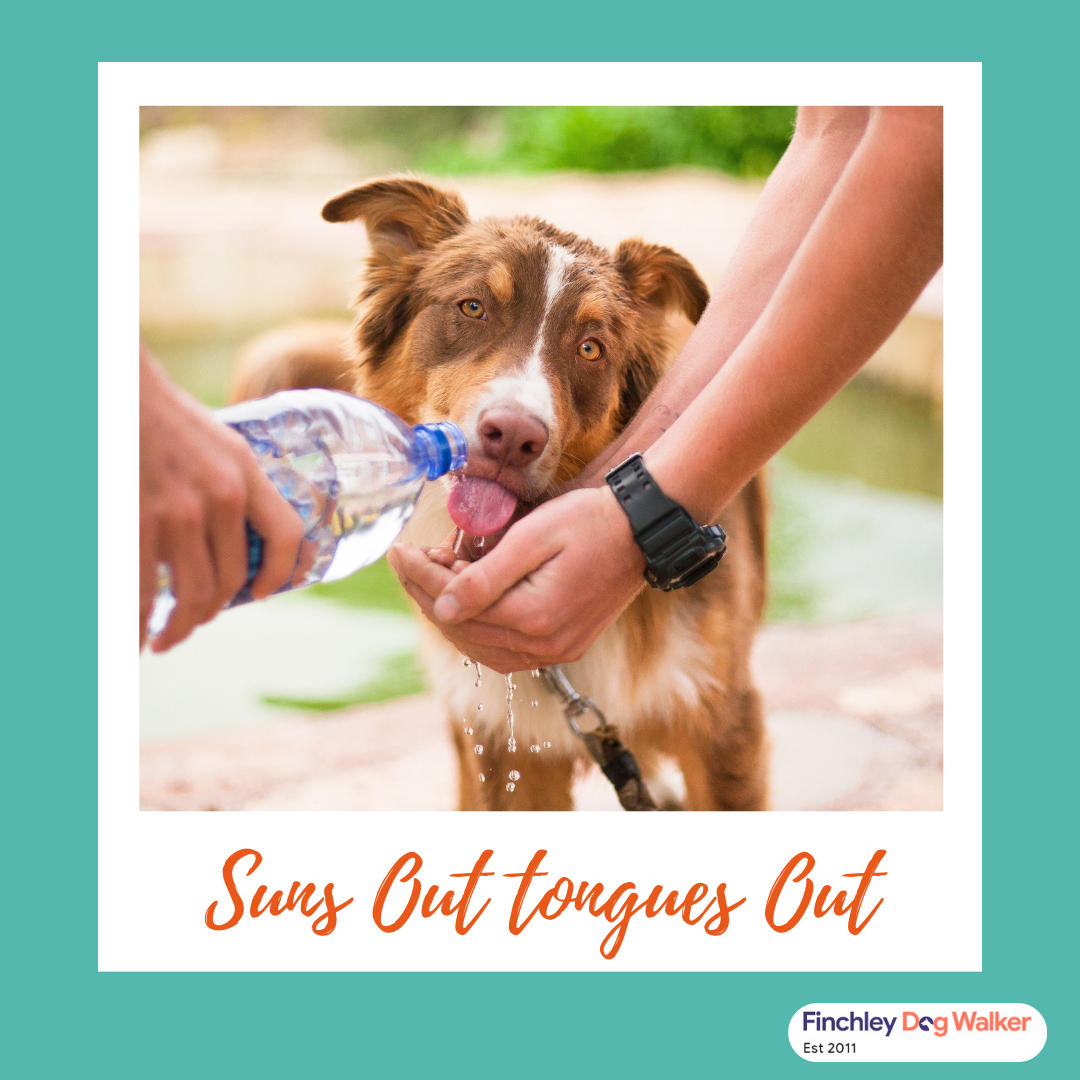
My article on why dogs need sniff walks rather than human step targets explains why I am perfectly happy to let a dog slow down and investigate their surroundings.
Your fitness watch does not need to be impressed by your dog’s walk.
Which dogs are more at risk in hot weather?
Every dog can overheat.
But some dogs need much more care.
PDSA highlights additional concerns for dogs who are flat-faced, overweight or have a thick coat. Its heatstroke guidance also advises avoiding exercise completely on hot days for dogs who are elderly, young, unfit, unwell or have breathing difficulties.
Flat-faced dogs
Pugs.
French Bulldogs.
English Bulldogs.
Shih Tzus.
Boston Terriers.
And other dogs with shortened faces.
These dogs can find it hard to cool themselves, so they breathe much harder.
Please do not compare your flat-faced dog’s walk with the Labrador running around the park.
Different dog.
Different risk.
Older dogs
I talk about this a lot.
We have a bad habit of expecting dogs to follow the same routine year after year.
Your dog walked for an hour when they were five.
They are now twelve.
Their body has changed.
Perhaps their movement has changed.
Their recovery may take longer.
They may be living with health problems you cannot immediately see.
Hot weather is not the time to insist they keep up.
Overweight dogs
Extra weight can make it harder for a dog to cope with heat.
This is another reason I dislike blanket temperature charts.
Two dogs of the same breed and age may have very different fitness and body conditions.
Puppies
Puppies do not need to be dragged around the park to “tire them out”.
Especially in hot weather.
Toilet breaks.
Calm play.
Training.
Sniffing.
Rest.
My Puppy Visits in Finchley are based around the puppy in front of me rather than trying to force an adult dog’s routine onto them.
Dogs with health or breathing problems
Speak to your vet about your individual dog.
I am a dog walker.
I am not going to overrule your vet because a graphic on Facebook says the temperature is “amber”.
If your dog has heart problems, breathing difficulties or another condition that may affect how they cope with exercise or temperature, get proper veterinary advice.
Humidity matters too
This is something owners sometimes miss.
You look at the temperature.
It does not seem too bad.
But the air feels heavy.
Your dog starts panting much earlier than usual.
Do not ignore that because the weather app says it is only 20°C.
I look at the dog.
Is their panting becoming heavier?
Are they slowing down?
Are they constantly seeking shade?
Have they stopped sniffing?
Are they reluctant to continue?
Has their behaviour changed?
Your dog is giving you information.
Listen to them.
Early morning is often better than waiting until late evening
“Just walk later.”
It sounds sensible.
But during very hot weather, pavements and buildings may have absorbed heat all day.
The air temperature may have dropped.
The ground may still feel hot.
Humidity can also remain uncomfortable.
I prefer early mornings where possible.
The sun has not spent hours heating pavements and roads.
The streets may be quieter.
For nervous and reactive dogs, that can be a bonus.
But again, check the actual conditions.
Do not assume 8 pm automatically means safe.
Check the pavement before walking your dog
We wear shoes.
Dogs do not.
Tarmac, paving, artificial grass and other surfaces can become hot.
I use a very simple check.
Put your hand on the surface.
Can you keep it there comfortably for several seconds?
If it feels painfully hot to you, do not ask your dog to walk along it.
The Royal Kennel Club recommends a seven-second pavement test.
You can read more in my guide to walking dogs on hot pavements and protecting their paws.
And remember.
Getting your dog across 500 metres of hot pavement to reach a shady park is still 500 metres of hot pavement.
Think about the whole route.
But my dog is asking for a walk
I hear this one a lot.
“My dog is desperate to go.”
Of course they are.
Dogs also ask for food they should not eat.
Some dogs will chase a ball until they physically cannot continue.
Your dog does not check the Met Office forecast.
You make the safety decision.
Missing one walk will not harm a healthy dog.
Forcing a normal exercise routine during dangerous heat can be dangerous.
The RSPCA has highlighted exercise as a major risk of heatstroke and recommends puzzle toys, training games, and scent work when normal exercise is unsafe.
My guide to what to do instead of walking your dog in a heatwave includes 15 calm ideas.
And the word calm matters.
I am not trying to recreate an hour of physical exercise in your living room.
Your dog is allowed to rest.
What I do instead of a normal walk
Depending on the dog, I may use:
- a short toilet opportunity
- a simple Find It game
- scatter feeding
- a cardboard search box
- a frozen Kong
- a lick mat
- calm scent work
- a little training
- quiet companionship
- rest
Rest is not failing your dog.
Your dog does not need to be exhausted every day.
For food-based enrichment, I often use part of the dog’s normal meal.
That stops us adding handful after handful of treats simply because the dog missed a walk.
My healthy summer treats and frozen enrichment guide has some simple ideas.
You can also read my “Ditch the Bowl at Mealtimes” guide for ways to turn everyday food into calm mental enrichment.
The few hot-weather products I actually find useful
You do not need to buy half of Amazon because the weather forecast says 27°C.
Equipment does not make an unsafe walk safe.
A cooling product is not permission to walk your dog at midday.
But a few simple things can be useful.
A portable dog water bottle
I carry water during warmer walks.
A portable dog water bottle makes it easier to offer water without carrying a separate bowl.
But remember.
Having water with you does not magically prevent heatstroke.
The Royal Kennel Club specifically warns that heatstroke can still happen even when a dog has access to water.
A collapsible water bowl
A collapsible dog bowl is simple.
It packs down.
It is easy to carry.
And it means you can offer your dog their own clean water rather than relying on communal bowls left outside cafés or shops.
A cooling mat for home
I see cooling mats as somewhere a dog can choose to rest.
Not a medical treatment.
Not an excuse for a hot walk.
A cooling mat for dogs may provide a more comfortable resting place at home.
Let your dog choose whether to use it.
A LickiMat
For dogs who enjoy food enrichment, a LickiMat Classic Dog Mat can be useful.
I may use:
- the dog’s normal wet food
- soaked kibble where suitable
- another dog-safe food the owner already knows the dog tolerates
You can freeze it in advance.
Keep portions sensible.
A Kong
A KONG Classic Dog Toy is another simple option.
Part of a dog’s normal meal can be prepared and frozen in advance.
My complete guide to Kong toys for dogs covers sizes, fillings and practical ideas.
You can see all the simple items I recommend in my Hot Weather Dog Kit.
I deliberately keep that kit simple.
Water.
Shade.
Rest.
Calm enrichment.
Good decisions.
The decisions matter more than the shopping.
Signs your dog may be getting too hot
Do not wait for your dog to collapse.
Watch for changes.
The RSPCA lists signs of heatstroke including:
- heavy panting
- excessive drooling
- lethargy
- drowsiness
- uncoordinated movement
- collapse
- vomiting
I also pay attention to the dog in front of me.
Are they suddenly slowing down?
Stopping?
Seeking shade?
Lying down?
Panting far more heavily than I would expect?
Do they simply look wrong?
You know your dog.
A sudden change matters.
Heatstroke is an emergency.
If you think your dog is overheating, stop the exercise and move them out of the heat.
Start cooling them and contact a vet immediately for advice.
Current Royal Kennel Club guidance advises stopping exercise, moving the dog into shade, contacting a vet and carefully pouring water over the dog’s body while cooling continues.
Read the Royal Kennel Club heatstroke and warm-weather walking advice.
Do not delay contacting your vet because you are searching Facebook for a home remedy.
What about wet towels and cooling bandanas?
This is another area where social media advice becomes confusing.
I recently saw an article recommending putting a wet bandana around a dog’s neck.
I was not immediately convinced.
Why?
Because putting something wet on a dog and putting something wet over a dog are not automatically the same thing.
Material.
Design.
Airflow.
How wet it is.
Where it sits.
Whether it warms up.
All of these matter.
The RSPCA specifically advises owners not to place a damp towel over an overheating dog because it can trap heat.
That is why I do not blindly recommend every product with the word “cooling” on the packaging.
Read my Hot Weather Dog Care Myths guide.
My view is simple.
Never rely on a gadget to fix a bad decision.
If it is too hot for the walk, change the walk.
What I do as a professional dog walker during hot weather
I have walked dogs professionally since 2011.
And I am far more cautious about hot weather now than I was when I started.
Experience should change how you work.
I assess:
- the individual dog
- age
- health
- mobility
- breathing
- breed or type
- coat
- fitness
- temperature
- humidity
- direct sunlight
- shade
- surfaces
- local conditions
I do not promise that a sixty-minute booking means sixty minutes pounding the pavement.
A normal walk may be:
- shortened
- moved to a cooler time where practical
- slowed down
- changed to a short toilet opportunity
- replaced with calm home-based care
An adapted visit may include:
- fresh water
- a short toilet opportunity
- calm indoor enrichment
- a scent game
- feeding
- agreed medication
- preparing an owner-supplied Kong or lick mat
- a general welfare check
- a photograph and update
You can read more about my Hot-Weather Dog Comfort Visits in Finchley.
My Extreme Weather Policy also explains how and why I change walks.
I know some dog walkers worry about upsetting clients.
I understand that.
When you are self-employed, cancelled walks mean lost income.
But the dog still has to come first.
I would rather have an awkward conversation with an owner than knowingly push their dog through unsafe conditions.
And as a dog owner, you should never be afraid to ask your dog walker about their hot-weather plan.
Ask them.
What happens if the temperature suddenly rises?
Do they shorten walks?
Do they change times?
Do they carry water?
Do they check pavements?
What happens to dogs booked at midday?
Do they have an extreme weather policy?
A professional dog walker should be able to answer those questions.
So, how hot is too hot to walk your dog?
There is no single temperature that is safe for every dog.
But here’s how I think about it.
At around 18°C to 20°C, I start paying more attention to vulnerable dogs and the conditions.
Above 20°C, I become increasingly cautious and start considering route, pace, shade and whether the walk needs adapting.
As temperatures move into the mid-twenties, I stop thinking about completing a normal walk and start asking whether that dog needs to be walked at all.
During extreme heat, I focus on essential toilet opportunities, water, shade, calm enrichment and rest.
That is my practical dog-walker approach.
It is not a veterinary cut-off chart.
Your dog may struggle sooner.
Watch them.
Know them.
And be prepared to change the plan.
One missed walk is not a disaster.
Please do not risk your dog because the clock says it is walk time.
Read my Summer Dog Safety Guide for my complete hot-weather advice.
For the simple products I use or recommend, see my Hot Weather Dog Kit.
And if you are a regular client, my Extreme Weather Policy explains exactly how I adapt booked walks when conditions are unsuitable.
Frequently asked questions
Is 20°C ok to walk my dog?
Some dogs may already struggle at 20°C, particularly flat-faced dogs, older dogs, overweight dogs and dogs with health or breathing problems.
Consider humidity, direct sunlight, surfaces and the intensity of exercise.
Watch your individual dog rather than relying on the temperature alone.
Is 25°C too hot to walk a dog?
At around 25°C, I would be very cautious about a normal walk for a dog.
Some dogs may need to avoid exercise completely.
I would think about an early toilet break, a much shorter outing or calm indoor enrichment instead.
Can I walk my dog at 8 pm during a heatwave?
Check the actual conditions.
The air may be cooler, but pavements and buildings can retain heat after hours of sunshine.
Humidity can also remain high.
Early morning is often my preferred option.
Does shade make a dog walk safe?
No.
Shade can help, but dogs can still overheat during exercise.
Consider temperature, humidity, the individual dog and how hard they are working.
Is it safe to walk a dog if I carry water?
Water is important, but carrying water does not make an unsafe walk safe.
Dogs can still develop heatstroke even when water is available.
Do dogs need a walk every day during a heatwave?
A dog does not need to complete their normal walk during unsafe heat.
Use calm enrichment, scent work, food activities and rest instead.
Which dogs struggle most in hot weather?
Flat-faced dogs, older dogs, overweight dogs, unfit dogs, puppies, dogs with thick coats and dogs with health or breathing problems may require additional care.
Speak to your vet about your individual dog’s health.
What should I do if my dog is showing signs of heatstroke?
Stop exercise immediately.
Move your dog out of the heat.
Start cooling them.
Contact a vet urgently and follow their advice.
Do not wait to see whether serious symptoms improve on their own.
Disclaimer
This article provides general dog-care information and does not replace veterinary advice. Every dog’s health and ability to cope with heat is different. If your dog has a medical condition or has struggled in hot weather before, speak to your vet about safe exercise. Heatstroke is an emergency. If you think your dog is overheating, start cooling them and contact a vet urgently.
Here are some other posts you may be interested in