updated Jan 2025 and March 2026
This article may contain Amazon affiliate links. If you purchase through these links, I may earn a small commission at no extra cost to you. I only recommend products I would genuinely use with dogs in my care.
One of the most common questions dog owners ask me is simple.
How much exercise does a dog need?
It sounds like an easy question. The reality is more complicated.
The amount of exercise your dog needs depends on several things:
- breed
- age
- health
- personality
- lifestyle
Two dogs of the same breed can have completely different exercise needs.
A young Border Collie will need far more activity than an elderly Shih Tzu. However, even smaller companion breeds still need daily exercise and mental stimulation.
Over the years, while walking dogs across Finchley, Muswell Hill, and the surrounding areas, I have seen firsthand what happens when dogs do not get enough exercise.
- Dogs become frustrated.
- They bark more.
- They chew things.
- They struggle to settle.
On the other hand, too much exercise can also cause problems. Over-exercised dogs can develop joint injuries, fatigue, or behavioural issues.
The goal is not simply to tire your dog out.
The goal is to create a balanced routine that supports physical and mental wellbeing.
In this guide, I will explain:
- How much exercise do most dogs need
- How exercise varies by breed and age
- Why mental stimulation matters as much as walking
- How to recognise when your dog needs more or less activity
Why Exercise Matters for Dogs
Exercise is not just about burning energy.
It supports almost every part of your dog’s wellbeing.
Regular exercise helps with:
- weight management
- muscle strength
- joint health
- mental stimulation
- confidence building
- behaviour
Dogs are natural explorers. Their main way of understanding the world is through scent.
Sniffing new environments provides mental stimulation that cannot be replicated in the garden.
According to the PDSA, most dogs benefit from at least one or two walks per day, combined with play and mental activity. (PDSA) As walking alone does not always tire dogs
Exercise also strengthens the bond between you and your dog.
Walking together builds trust and communication.
How Much Exercise Does a Dog Need Each Day?
A general guide for many healthy adult dogs is:
60 to 90 minutes of activity each day.
This can be split into two walks plus playtime.
Some dogs will need more.
Some will need less.
High-energy breeds such as Labradors, Spaniels and Border Collies often thrive on one to two hours of daily activity.
However, this does not mean constant running.
A varied routine works best.
This might include:
- walking
- sniffing time
- training games
- gentle play
- exploring new routes
Walking should allow your dog time to stop and investigate smells.
Sniffing is mentally tiring and an extremely valuable enrichment.
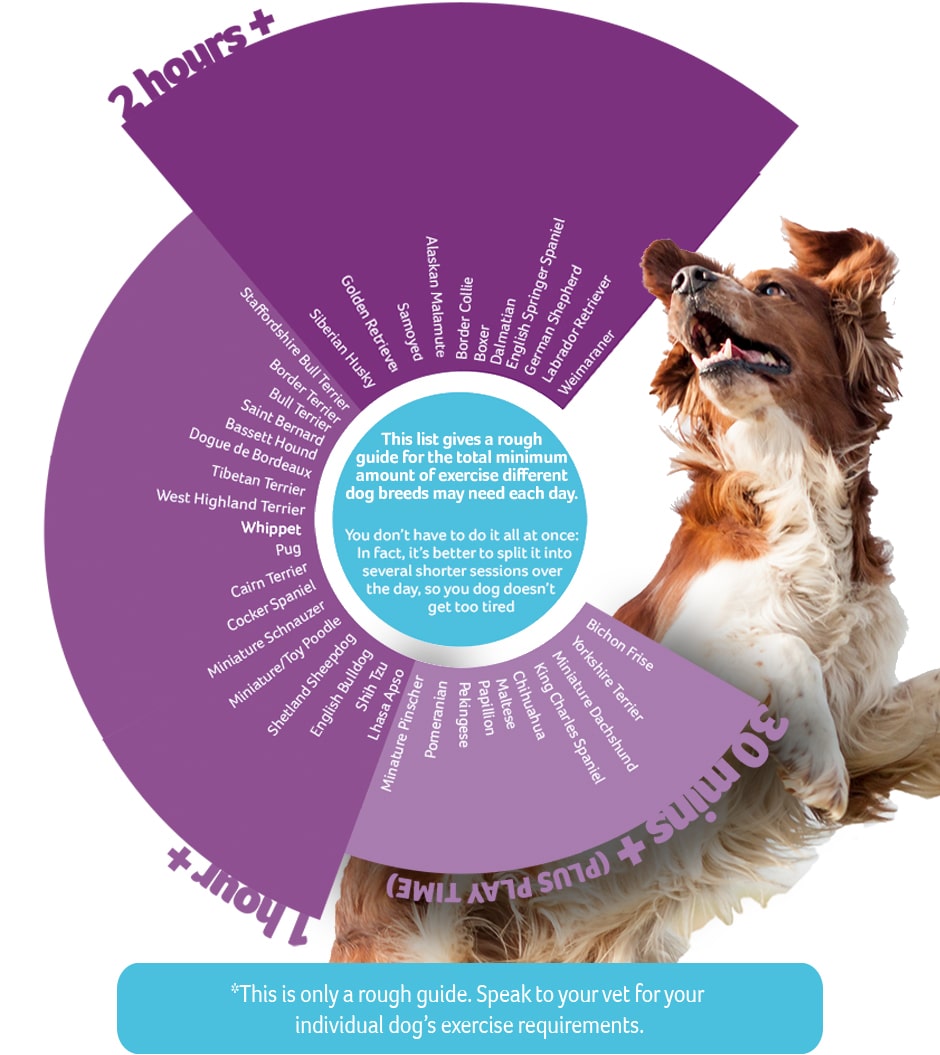
Exercise Needs by Breed and Energy Level
Breed gives a rough idea of exercise needs.
However, personality matters as much.
Low energy breeds
Examples include:
- Bulldogs
- Basset Hounds
- Shih Tzus
- Cavalier King Charles Spaniels
These dogs may only need 30 to 45 minutes of daily exercise.
They still benefit from daily walks and mental enrichment.
Medium energy breeds
Examples include:
- Cockapoos
- Dachshunds
- Cocker Spaniels
- Terriers
These dogs often need 45 to 75 minutes per day.
High energy breeds
Examples include:
- Border Collies
- Labradors
- Springer Spaniels
- Dalmatians
These breeds may need 90 minutes or more daily.
Working breeds often require additional mental stimulation.
Without it, they may become bored and frustrated.
Exercise for Puppies, Adult Dogs and Seniors
Age plays a huge role in determining exercise needs.
Puppies
Puppies are still developing.
Too much exercise can damage growing joints.
A common guideline is:
Five minutes of exercise per month of age
For example:
A four-month puppy
about 20 minutes of structured exercise
Puppies also benefit from:
- training games
- exploration
- short social experiences
Adult dogs
Healthy adult dogs can cope with longer walks.
Most thrive with:
- Two walks per day
- play sessions
- mental stimulation
Senior dogs
Older dogs still need exercise.
However, the focus should shift to:
- gentle walks
- slower pace
- shorter distances
Many senior dogs enjoy sniffing walks more than fast walks.
If your dog has arthritis or mobility issues, always consult your vet.
Physical Exercise vs Mental Stimulation
Many owners focus purely on physical exercise.
Mental exercise is just as important.
In some cases, it is more effective at tiring a dog.
Mental enrichment can include:
- scent games
- puzzle feeders
- training games
- scatter feeding
- sniff walks
Dogs that use their brains regularly often settle better at home.
Simple enrichment ideas include:
- Scatter feeding part of your dog’s meal in the grass.
- Using a lick mat. (amazon)
- Using puzzle toys. (amazon)
These activities encourage natural behaviours such as sniffing, searching and problem solving.
Signs Your Dog Needs More Exercise
A dog that is not getting enough stimulation may show signs such as:
- excessive barking
- chewing furniture
- digging
- restlessness
- hyperactivity indoors
These behaviours are often mistaken for bad behaviour.
In reality, they are usually signs of boredom.
Increasing both physical and mental activity can help reduce these problems.
Signs Your Dog Is Getting Too Much Exercise
Too much exercise can also cause issues.
Signs may include:
- extreme tiredness
- limping
- reluctance to walk
- joint stiffness
- slower recovery
Dogs, especially young, energetic ones, will often keep going even when tired.
This is why it is important to monitor your dog’s recovery after walks.
A healthy walk should leave your dog relaxed but not exhausted.
Realistic Exercise Ideas for Busy Owners
Not every owner can spend hours walking each day.
The good news is that exercise does not need to be complicated.
Simple ways to increase activity include:
- Short training sessions, even kettle training – this is where you do some basic training or enrichment whilst waiting for the kettle to boil
- Hide and seek games
- Sniff walks rather than fast walks
- Rotating walking routes
- Play sessions with toys
If your schedule makes it difficult to maintain a regular exercise routine, a professional dog walker can help you keep a consistent routine.
You can learn more about my services here:
My focus is on calm, one-to-one walks that suit each dog’s personality and energy level.
Updated March 2026 – The Shift Towards Enrichment
Dog care advice has changed over the last decade.
Many trainers now focus less on exhausting dogs physically and more on balanced enrichment.
This includes:
- sniff walks
- brain games
- food puzzles
- training games
These activities reduce stress and build confidence.
They are especially helpful for:
- rescue dogs
- nervous dogs
- reactive dogs
Short, calm walks combined with enrichment often produce better results than long, fast walks.
Supporting This Guide
I spend a lot of time researching and updating guides like this so local dog owners can find reliable information.
If you find this guide helpful and would like to support the work that keeps Finchley Dog Walker running, you can buy me a coffee.
Your support helps me keep producing free guides and advice for dog owners.
Frequently Asked Questions
Most dogs benefit from two opportunities to go outside each day. This does not always mean two long walks. One longer walk and a shorter sniff walk can work well.
Gardens are great for toilet breaks and short play sessions. However, they rarely provide enough mental stimulation. Dogs benefit from exploring new environments and smells.
A well-exercised dog should be relaxed and calm when returning home. They should not appear exhausted or reluctant to move.
Yes. Over-exercising can cause joint strain, especially in puppies and older dogs. Always build exercise gradually.
The best routine combines walking, sniffing, play and training. Variety keeps dogs mentally and physically stimulated.
Conclusion
So, how much exercise does a dog need?
For most dogs, the answer is between 45 minutes and 90 minutes per day, combined with mental enrichment.
However, every dog is different.
Age, breed, health and personality all influence how much activity your dog needs.
The key is balance.
Your dog should come home relaxed, satisfied and able to settle.
Exercise should not just focus on distance or speed.
Sniffing, exploring, and learning are just as important.
When dogs receive the right amount of stimulation,n they tend to be calmer, happier and easier to live with.
Resources
The Kennel Club
https://www.thekennelclub.org.uk
Remember, as a games-based dog walker and trainer that specialises in rescue dogs, if you require any help, then please get in touch via WhatsApp 07707 76334 or visit my service page