Trying to decide between hiring a dog walker and booking doggy day care?
Both can help when you’re working or need to be away from home. But they offer very different experiences for your dog.
A dog walker usually visits your home, takes your dog out for an agreed walk and returns them afterwards. Doggy day care generally means your dog spends part or all of the day at another location, with staff providing care, supervision and activities.
Neither option is automatically better.
A confident, sociable dog may enjoy a carefully managed daycare environment. Another dog may prefer staying in familiar surroundings and having somebody visit for a quiet, individual walk.
And some dogs need more support than either arrangement provides on its own.
I’m Del, and I’ve been providing professional dog walking and pet care around Finchley and North London since 2011.
I specialise in calm, one-to-one care, particularly for dogs who benefit from individual attention, predictable routines and walks at their own pace.
That doesn’t mean I think every dog should have a solo walker or that daycare is unsuitable.
It means I believe we should choose the arrangement that suits the dog, rather than expecting the dog to fit whatever is most convenient for us.
Let’s look at the differences.
Dog Walker vs Doggy Day Care: What’s the difference?
| Dog Walker | Doggy Day Care |
|---|---|
| Usually visits the dog at home | Dog attends a separate daycare location |
| Provides agreed walks or visits | Provides care over a longer part of the day |
| Dog normally returns home afterwards | Dog remains at the facility until collection |
| May offer solo or group walks | May provide individual and group activities |
| Familiar home remains the dog’s base | Dog must become comfortable with another environment |
| Suitable for dogs who cope well between visits | May suit dogs needing more daytime supervision |
| Care depends on the service booked | Supervision and activities depend on the facility |
A dog walker is not necessarily a group walker.
Some dog walkers collect several dogs and take them out together.
Others, including me, offer individual walks from the dog’s own home.
Similarly, not every daycare facility works in the same way.
Good facilities should assess individual dogs, manage interactions carefully, provide opportunities to rest and avoid forcing unsuitable dogs into group activities.
What are the advantages of hiring a dog walker?
1. Your dog can remain in familiar surroundings
For some dogs, this is the biggest advantage.
They can spend most of their day at home, with their own bed, familiar smells and ordinary household routine.
The walker arrives at an agreed time, provides the booked care and returns the dog afterwards.
This can be particularly helpful for dogs that are uncomfortable in unfamiliar places or get overwhelmed in busy environments.
2. Walks can be adapted to the dog
A good dog walker should consider your dog’s age, health, fitness, confidence and preferences.
For example:
- A young, healthy adult might enjoy a longer walk with plenty of sniffing.
- An older dog may prefer a slower outing with more frequent stops.
- A nervous rescue dog may need familiar streets and extra distance from other dogs.
- An adolescent dog may benefit from manageable distractions and reward-based practice.
- A dog recovering from illness may require a restricted routine agreed with their vet.
The number of miles covered isn’t necessarily a measure of a successful walk.
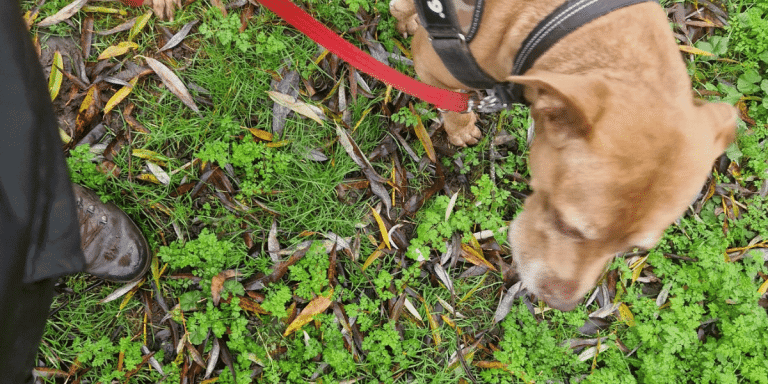
Sometimes the most useful thing a dog does is spend a little time investigating an interesting patch of grass.
3. Solo walks reduce the pressure of a group
With individual walks, your dog doesn’t have to keep up with unfamiliar dogs or cope with repeated social interactions.
This doesn’t mean all group walks are bad.
A suitably managed group walk can be enjoyable for compatible dogs.
But a dog who is nervous, reactive, senior or easily overwhelmed may be more comfortable walking alone.
For more detail, read my Solo Dog Walks vs Group Dog Walks Guide.
4. It may fit your existing routine
A visit at the right time of day can provide a welcome break.
Your dog may have an opportunity to toilet, exercise, sniff and enjoy some company before returning home to rest.
You also avoid the extra journey of dropping off and collecting a dog from a daycare facility.

What are the disadvantages of a dog walker?
The dog is still alone between visits
A dog walker isn’t normally providing continuous care.
If your dog struggles with being alone, a mid-day walk may not be enough to meet their needs.
Consider the entire period you’re away, including travelling to and from work.
Visits are booked for a particular duration
A standard dog-walking appointment won’t provide the same length of supervision as a full daycare booking.
If your dog requires frequent meals, medication, toilet opportunities or company, you may need several visits or a different care arrangement.
The quality of the service varies
Not every dog walker offers the same level of experience, preparation, insurance or individual attention.
Ask about equipment, handling methods, emergency arrangements and how the walker manages situations involving other dogs.
I would always recommend an appropriate introduction before booking ongoing care.
What are the advantages of doggy day care?
1. Longer periods of supervision
The main advantage of daycare is that the facility cares for your dog during the agreed hours.
This can be useful when you’re away for much of the workday and a single dog walk leaves too many hours without care.
2. Suitable social opportunities
Some dogs enjoy spending time around other compatible dogs.
A well-managed daycare facility can provide appropriate social interaction, play and enrichment.
However, socialisation shouldn’t mean simply putting a large number of dogs together and hoping they’ll get along.
Dogs need careful assessment, suitable groupings and opportunities to move away.
3. Activities throughout the day
Depending on the facility, daycare may include:
- Supervised play.
- Comfortable resting periods.
- Appropriate walks.
- Food-based enrichment.
- Gentle games.
- Individual attention.
- Feeding where required.
- Toilet opportunities.
- Quiet spaces away from other dogs.
Ask what an ordinary day actually involves rather than assuming that a longer booking means constant activity.
4. A consistent daytime routine
Some dogs settle well into a predictable daycare routine.
They become familiar with the staff, surroundings and other suitable dogs.
For the right animal and a well-run facility, this can be a positive arrangement.
What are the disadvantages of doggy day care?
It can be overwhelming for some dogs
A busy environment may involve barking, movement, unfamiliar smells and interactions with other dogs.
Some dogs find that enjoyable.
Others find it stressful.
A dog who is quiet at daycare isn’t necessarily relaxed. They may be frightened or withdrawn.
Daycare staff should be able to recognise subtle signs of discomfort rather than relying entirely on whether a dog is barking or behaving aggressively.
Not every dog enjoys group interaction
Dogs don’t have to play with other dogs all day to have a fulfilling life.
Some prefer people.
Some enjoy observing other dogs without interacting.
Others need substantial distance from unfamiliar animals.
A suitable facility should recognise these differences and have arrangements for dogs who need space.
Rest can be difficult in busy surroundings
Dogs need opportunities to sleep and recover throughout the day.
Repeated excitement without suitable breaks may leave some dogs overtired or unable to settle.
When visiting a daycare facility, ask where dogs rest and whether they can relax away from other animals.
Transport adds another part to the day
If the daycare is not close to home, you’ll need to consider the journey.
Some dogs travel happily.
Others find vehicles stressful or become sick.
Where collection and delivery are offered, ask how transport is managed, how long dogs spend travelling and how they’re secured.
It may not suit dogs with particular needs
A puppy, older dog, nervous rescue dog or animal recovering from illness may need arrangements that a particular facility cannot provide.
That doesn’t rule out every daycare setting.
It does mean suitability needs to be assessed individually.
Does doggy day care need a licence?
In England, commercial dog daycare businesses generally require a local authority licence under the Animal Welfare (Licensing of Activities Involving Animals) (England) Regulations 2018.
There are specific criteria for determining whether an activity falls within the licensing requirements.
Before booking a daycare facility, ask to see its current licence and check the relevant local authority information.
The GOV.UK statutory guidance for dog daycare licensing explains the requirements.
Among other things, licensed facilities must have appropriate arrangements for:
- Assessing whether dogs are suitable for the environment.
- Managing compatible groups.
- Separating dogs when necessary.
- Providing suitable accommodation.
- Allowing dogs to rest.
- Providing appropriate enrichment and exercise.
- Maintaining hygiene.
- Managing health concerns and emergencies.
A licence is an important check, but you should still visit the facility, ask questions and consider how your individual dog responds.
Does a dog walker need the same licence?
No, not for ordinary dog walking alone.
In England, providing dog walking or pet sitting in the owner’s own home is not the same licensable activity as operating commercial dog daycare premises.
Other legal duties and local requirements may still apply, including dog-control rules and restrictions in particular public spaces.
Don’t assume that every type of pet-care service operates under the same licensing arrangements.
Rules also differ across the UK, so check the requirements that apply if you’re outside England.
How long can you leave a dog alone while you’re at work?
This is probably the most important question in the whole comparison.
Dogs are social animals, but their ability to cope with time alone varies.
An adult dog who has gradually learnt to settle may cope comfortably with periods of independence.
A newly adopted rescue dog, a very young puppy, or a dog experiencing separation-related distress may not.
Dogs Trust and Blue Cross recommend avoiding leaving dogs alone for longer than four hours, and some dogs need much shorter periods.
That is welfare guidance, not a universal law that makes four hours automatically suitable for every dog.
Does a lunchtime dog walk solve the problem?
It depends.
Imagine you leave home at 8 am and return at 6 pm.
A dog walker visits at 1 pm for an hour.
Your dog still spends substantial periods without company before and after the visit.
For some dogs, that may be too much.
And a very young puppy may need far more frequent care than a single walk can provide.
You need to plan the whole day.
That could involve:
- Changes to your working arrangements.
- Help from family or trusted friends.
- Appropriate professional visits.
- Suitable daycare.
- A combination of arrangements.
If your dog cannot cope with being alone, simply booking a walker halfway through the day may not resolve the underlying problem.
For more guidance, read my Helping Your Dog Cope With Being Left Alone guide.
Significant separation-related distress may require veterinary advice and support from an appropriately qualified behaviour professional.
Which option is best for your dog?
The best choice depends on the individual dog and your circumstances.
Puppies
Young puppies need frequent toilet opportunities, suitable feeding, companionship and plenty of rest.
They shouldn’t be expected to manage an adult dog’s routine immediately.
Some specialist daycare facilities may offer suitable puppy arrangements. Others may not accept very young puppies.
Home-based puppy visits can also be helpful, although one short visit may not provide sufficient care for a full working day.
My Puppy Visits in Finchley provide individual care at home, subject to suitability and availability.
For broader preparation, see my Bringing a Puppy Home Guide.
Nervous or reactive dogs
A busy daycare environment may be unsuitable for some nervous or reactive dogs, particularly if they struggle with unfamiliar dogs or people.
One-to-one walking can offer more control over routes, distance and encounters.
However, the dog must also be comfortable with the walker entering the home and handling them.
For suitable local dogs, I offer Rescue Dog Support and individual walks.
I don’t describe these as behavioural treatment, and some dogs may need additional veterinary or specialist help.
Senior dogs
Older dogs may benefit from gentle movement, toilet opportunities and a predictable routine.
For some, remaining in familiar surroundings is preferable to travelling to a busy facility.
Others may enjoy a calm daycare environment with suitable rest arrangements.
Consider mobility, medication, pain, sensory changes and the dog’s normal preferences.
Confident, sociable adult dogs
A healthy adult who enjoys compatible dogs and settles comfortably in group environments may do well at an appropriately managed daycare facility.
Equally, they may enjoy an individual walk followed by a peaceful afternoon at home.
Being sociable doesn’t mean a dog must attend daycare.
Dogs needing continuous supervision
A single dog-walking appointment cannot replace continuous care.
Where a dog has significant medical requirements, cannot safely be left or needs close supervision, look for an arrangement that can genuinely meet those needs.
Be clear with any provider about medication, health conditions, mobility and behaviour before booking.
Questions to ask a dog walker
Before booking, I’d ask:
- Are walks solo or in groups?
- Will my dog travel in a vehicle?
- What experience do you have with dogs like mine?
- Are you insured for the activities you’re providing?
- What happens if my dog becomes frightened, injured or unwell?
- What walking equipment and training methods do you use?
- Will my dog be let off the lead, and under what conditions?
- How are keys and home access managed?
- What happens during severe weather?
- Will we have a meet-and-greet before regular walks begin?
You can also read my Solo vs Group Dog Walking Guide.
Questions to ask a daycare provider
I would ask:
- Can I see the current local authority licence?
- How do you assess whether a new dog is suitable?
- How many dogs attend, and how are they supervised?
- How do you group dogs by temperament, age, size and needs?
- What happens if my dog wants to avoid other dogs?
- Where can dogs sleep and rest undisturbed?
- How do you prevent and manage disagreements or fights?
- What is the policy on vaccinations and infectious illness?
- What happens if a dog becomes injured or unwell?
- Can we arrange a suitable introductory or trial session?
I would also ask what handling and training methods you use.
I favour reward-based approaches and wouldn’t choose a service that relies on frightening or painful corrections.
You should feel comfortable asking these questions.
A good provider should be willing to explain how the service operates and whether it’s suitable for your dog.
How can you tell whether your dog likes their care arrangement?
Don’t judge the arrangement solely by how excited your dog appears when they arrive or how tired they are afterwards.
Look at the whole experience.
Positive signs may include:
- Comfortable body language during familiar routines.
- Willingness to approach the carer or facility.
- Appropriate interest in activities.
- Opportunities to disengage and rest.
- Normal appetite, toileting and recovery afterwards.
- No persistent signs of distress connected with the arrangement.
Possible signs of difficulty include:
- Reluctance to enter the facility or leave with the walker.
- Freezing or trying to escape.
- Repeatedly avoiding interactions.
- Excessive panting or pacing.
- Ongoing stress after returning home.
- Unusual withdrawal or changes in behaviour.
- Increasing sensitivity around other dogs.
These signs can have different explanations, including medical problems.
If the change is significant or persistent, speak to your vet and review the arrangement with the provider.
A good service should be willing to adjust care when a dog’s needs change.
My approach to solo dog walking in Finchley
I provide Solo One-to-One Dog Walks in Finchley and Muswell Hill.
My service is designed around the dog in front of me.
I don’t transport dogs in vans or combine unrelated households into groups.
Walks begin and finish at the dog’s own home.
Depending on the dog, we might visit a suitable local walking area, follow a familiar street route or spend more time sniffing and exploring.
I consider the dog’s age, health, confidence, preferences and the weather.
What does an individual walk include?
An agreed visit may include:
- Collection from your dog’s home.
- A suitable local walking route.
- Time to sniff and explore.
- Calm, reward-based handling.
- Appropriate exercise and enrichment.
- Additional space from other dogs when needed.
- Reinforcement of agreed everyday walking skills.
- A safe return home.
- An update where arranged.
I have been providing professional pet care since 2011 and hold an Ofqual Level 3 Canine First Aid qualification.
My service is fully insured, and I hold an Enhanced DBS check through my Scouting role.
I focus on individual care rather than fitting every dog into the same walking routine.
How much do solo walks cost?
I offer different arrangements, including shorter solo walks, standard one-hour walks and focused support walks for suitable dogs who need additional planning.
You can see my current prices and read the full Solo Dog Walking Service details.
Availability depends on your postcode, the days required and my existing commitments.
Because I work locally on foot, I need to make sure bookings are practical and reliable.
Do you offer doggy day care?
No.
I don’t operate a dog daycare centre or offer dog boarding.
My services include individual dog walking, suitable puppy visits and in-home pet sitting or house sitting by prior arrangement.
These are different services with different levels of care.
For holiday or overnight care in the pet’s own home, see my Pet and House Sitting Service.
I won’t recommend a solo walk when your dog genuinely needs a different level of supervision.
Frequently asked questions
Is doggy day care better than hiring a dog walker?
Neither is universally better. Daycare may suit dogs who need longer daytime supervision and are comfortable with the setting. A walker may suit dogs who prefer familiar surroundings and an agreed walk or visit.
Is doggy day care suitable for reactive dogs?
Some reactive dogs find group environments extremely difficult. A provider would need to assess whether a particular arrangement is safe and appropriate. For many dogs who need distance from unfamiliar animals, individual walking may be a better starting point.
Is day care good for socialising a puppy?
A carefully managed, age-appropriate experience can be useful for a suitable puppy. However, socialisation isn’t simply mixing with lots of dogs. Puppies need positive experiences, rest and protection from overwhelming situations.
Can a dog walker visit twice a day?
Some providers offer multiple visits, depending on their services and availability. The important question is whether the complete arrangement meets your dog’s care needs. Please ask me about availability rather than assuming several visits can be accommodated.
Does a dog walker need a daycare licence?
Ordinary dog walking does not fall under the same commercial dog daycare licensing activity in England. Different rules may apply to boarding or other services, and local restrictions may affect where and how dogs are walked.
How long can I leave my dog alone?
It depends on the individual dog. Dogs Trust and Blue Cross generally recommend no longer than four hours once a dog can cope comfortably with being alone, with shorter periods for some dogs. This is guidance, not a guaranteed safe duration for every animal.
Is a tired dog after daycare necessarily a happy dog?
No. Tiredness may follow enjoyable activity, but it can also follow stress or excessive excitement. Consider your dog’s body language, opportunities to rest and behaviour over time.
What if my dog doesn’t like daycare?
Speak to the provider about what you’re observing and whether changes are appropriate. If your dog remains distressed, a different care arrangement may be needed. Seek veterinary advice if you notice concerning or persistent changes.
Are solo walks only for nervous dogs?
No. Many confident, sociable dogs enjoy individual walks. Some owners choose them because they prefer a particular pace, route, routine or level of attention.
Can I combine dog walking and daycare?
Potentially, if both arrangements are appropriate and your dog has sufficient rest. More activity isn’t automatically better. Consider the dog’s response and avoid creating an unnecessarily demanding schedule.
Choosing the arrangement that suits your dog
There’s no prize for finding the busiest daycare centre or booking the longest walk.
A good arrangement should meet your dog’s physical, emotional and practical needs.
For one dog, that may mean attending a well-managed daycare facility with familiar staff and compatible dogs.
Yet for another, it may mean a calm individual walk followed by several hours of comfortable rest at home.
For a very young puppy or a dog struggling to be alone, the answer may be a more involved care plan.
I always encourage owners to look beyond convenience and ask whether the dog is genuinely comfortable.
If you’re based in Finchley or Muswell Hill and think individual walking might suit your dog, you’re welcome to contact me with your postcode, the days you need and a little information about your dog.
I’ll explain whether I can help and which service may be appropriate.
For more advice about choosing and caring for a dog, visit my New Pet Owner Hub.
First published: 17 September 2022
Substantially updated: 26 October 2026