

Updated July 2026
Dog walking would be easy if every day was dry, mild and calm.
But as you know in the UK We get heat, Heavy rain, Mud. Strong winds.Ice.etc
The occasional covering of snow that brings half of London to a standstill.
And sometimes all four seasons seem to turn up during the same week.
The important thing is not sticking rigidly to the same dog walk regardless of what is happening outside.
It is knowing when to change the plan.
My old collie would happily have gone out in almost any weather.
Cold?….Fine.
Rain? ……Did not care.
Snow….This is fun
Sun…..Not so kean
But I also had a Speagle who struggled much more when the weather turned cold or wet and loved the sunny weather
Same owner.
Different dogs.
Very different needs.
That is why I do not use one fixed rule for every dog I walk.
I look at the weather.
I look at the route.
But most importantly, I look at the dog in front of me.
A normal sixty-minute walk may sometimes become a shorter sniff walk.
I may choose a different route.
I may avoid the woods.
I may go out earlier where this has been agreed.
And occasionally the safest option is a quick toilet opportunity followed by calm care at home.
That is not a failed dog walk.
It is sensible pet care.
All of my professional walks are covered by my Finchley Dog Walker Extreme Weather Policy.
Don’t forget it is not just hot summer walks but also winter walks that can affect dog walking
Why weather changes a dog walk
Dogs do not all cope with weather in the same way.
I consider things such as:
- age
- health
- mobility
- breed or type
- coat
- fitness
- breathing
- normal behaviour
- how the dog is coping that day
The activity matters as well.
There is a big difference between a dog slowly sniffing around a shaded route and a dog pulling hard, chasing a ball or running continuously.
The ground matters.
The amount of shade matters.
Humidity matters.
Wind matters.
So does how your dog normally feels about being outside.
A nervous rescue dog may find strong winds far more difficult than a confident dog.
A senior dog with stiff joints may struggle on ice.
A flat-faced dog may need far more care during warm weather.
A short-haired dog may start feeling cold while another dog is still happily exploring.
The weather forecast gives me information.
The dog makes the decision.
That is one of the reasons I offer one-to-one solo dog walks rather than group walks.
I do not need six dogs to follow the same route at the same pace.
I can adapt the walk to the individual dog.
Dog walking in hot weather
Hot weather is where I make the biggest changes.
And I am far more cautious about it now than I was when I first started professionally walking dogs in 2011.
Experience should change how you work.
I no longer look at one temperature and say every dog is safe or unsafe.
I consider:
- the individual dog
- humidity
- direct sunlight
- shade
- ground temperature
- the route
- the length of the walk
- the intensity of exercise
That means I am moving away from the old advice on this page that suggested temperatures above 20°C were uncomfortable and 25°C was unsafe for most dogs.
It is too simple.
Some dogs may struggle earlier.
Others may cope better with a calm, brief outing in suitable conditions.
The question is not simply:
“What temperature is it?”
I ask:
“What am I expecting this particular dog to do in these conditions?”
I have written a separate guide answering how hot is too hot to walk your dog because it deserves a more detailed answer.
For my complete summer advice, start with my Summer Dog Safety Guide.
How I change dog walks in warm weather
I do not try to complete the normal walk simply because that is what the diary says.
Depending on the dog and the conditions, I may:
- move the walk to a cooler time where practical and agreed
- choose a more shaded route
- reduce the distance
- slow the pace
- allow more sniffing
- avoid open fields
- avoid strenuous exercise
- offer additional water and rest
- shorten the outdoor part of the visit
Sometimes I will decide that a normal walk is not appropriate at all.
The Royal Kennel Club advises walking during cooler parts of the day in hot weather and highlights exercise as the most common cause of canine heatstroke.
You can read the Royal Kennel Club heatstroke advice for dogs.
The RSPCA also provides useful practical advice on keeping dogs safe in hot weather.
A dog does not have to collapse before you change the plan.
I would rather end the walk early.
Hot pavements and North London streets
Walking locally on foot means I think about the whole route.
It is no good telling yourself that Highgate Woods will be shady if your dog has to cross several hot roads and walk along exposed pavements to get there.
Tarmac and other surfaces can become very hot in direct sunlight.
I assess the surface before continuing.
The Royal Kennel Club recommends a simple seven-second check using the back of your hand on the pavement.
But I would not use that as my only decision.
I also consider:
- direct sunlight
- the type of surface
- how long the dog will be exposed
- whether grass is available
- whether the dog already appears hot
My full guide to walking dogs on hot pavements explains this in more detail.
Artificial grass can also become very hot.
If you have it at home, read my guide to artificial grass and dogs in hot weather.
What happens when it is too hot for a normal walk?
Sometimes the answer is simple.
We do not do the normal walk.
That may feel wrong if your dog usually has an hour every afternoon.
But the weather does not care about your normal timetable.
Depending on the booking and the dog, adapted care may include:
- a brief toilet opportunity
- fresh water
- calm indoor enrichment
- scent games
- feeding
- agreed medication
- preparing an owner-supplied Kong or LickiMat
- quiet companionship
- a general welfare check
My Hot-Weather Dog Comfort Visits explain how I can adapt care when a normal walk is not sensible.
You can also read what to do instead of walking your dog in a heatwave for practical ideas at home.
And please remember this.
You do not have to replace every missed mile with frantic indoor activity.
Your dog is allowed to rest.
My guide to dog enrichment ideas that actually help calm and tire your dog gives you quieter options.
A few hot-weather products that can help
Good decisions matter more than products.
A cooling gadget does not make an unsafe walk safe.
But I do find a few simple things useful.
I carry water during warmer walks.
A portable dog water bottle can make offering water away from home easier.
At home, a cooling mat for dogs may give some dogs a cooler place to choose to rest.
For calm food enrichment, I also use or recommend things such as a LickiMat Classic Dog Mat or KONG Classic Dog Toy where these suit the individual dog.
Part of your dog’s normal food can often be used rather than adding lots of extra treats.
You can see the simple products I use or recommend in my Hot Weather Dog Kit.
That is the better page for product recommendations.
This page is about knowing when the walk needs to change.
What signs make me stop a hot-weather walk?
I watch the dog from the moment we leave home.
I am looking for changes.
That may include:
- unusually heavy panting
- heavy drooling
- difficulty breathing
- slowing down
- repeatedly seeking shade
- reluctance to continue
- weakness
- unsteadiness
- vomiting
- confusion
- collapse
Heatstroke can be fatal.
If I believe a dog may be overheating, the activity stops.
I move them to a cooler, well-ventilated place, begin appropriate cooling within my competence and seek veterinary advice promptly.
The RSPCA heatstroke advice for dogs explains the signs and the need to start cooling quickly.
If you think your own dog may have heatstroke, start cooling them and contact a vet urgently.
Do not wait for a Facebook group to decide whether the dog looks ill enough.
Walking dogs in rain
Rain itself does not automatically cancel a dog walk.
Some dogs love it.
You know the type.
The wetter they get, the happier they appear.
Other dogs stand at the front door, look at the rain and look back at you as though you have personally caused the weather.
I work with the dog in front of me.
A dog who is comfortable may still have their normal walk in moderate rain.
A dog who is cold, unhappy or becoming stressed may need a shorter outing.
The rain is only one part of my decision.
I also look at:
- wind
- visibility
- flooding
- slippery surfaces
- how cold it feels
- the dog’s response
My full guide to walking your dog in rainy and stormy weather covers puddles, floodwater, wet-weather kit and drying your dog after a walk.
A dog who hates rain does not need to be dragged through it
This is particularly important with nervous and rescue dogs.
I do not think forcing a frightened or uncomfortable dog around the park proves anything.
If a dog clearly dislikes heavy rain, I may keep the goal simple.
Toilet first.
A little sniffing.
Perhaps a short local loop.
Then home.
I would rather finish while the dog is still coping than turn every rainy day into a battle at the front door.
For sensitive dogs, this is where my approach to rescue and nervous dog support becomes useful.
Weather can change how a dog feels about their normal environment.
You may notice more hesitation.
More scanning.
More reactivity.
Or a dog who simply wants to go home.
Listen to them.
Strong winds can affect dogs more than owners realise
Wind is one of the most overlooked things on a dog walk.
On a windy day, everything moves.
Leaves.
Branches.
Bins.
Plastic bags.
Fences.
Signs.
For a nervous or reactive dog, the environment can suddenly feel very different.
Smells also move differently.
There may be more noise.
A dog who normally copes well on a familiar route may become more alert or distracted.
I have seen dogs react to things in strong winds that would barely get a glance on a calm day.
That does not mean the dog is being difficult.
The environment has changed.
How I adapt a walk in strong winds
I may:
- choose a familiar route
- avoid heavily wooded areas
- avoid exposed places
- stay closer to home
- shorten the walk
- watch the dog’s body language more closely
Safety for the human on the other end of the lead matters as well.
The Met Office advises staying indoors as much as possible in strong winds and avoiding walking or sheltering near buildings and trees.
You can check the Met Office weather warnings before setting out.
For severe conditions, read the Met Office advice on staying safe in strong winds.
If branches are falling or debris is being blown around, I am not taking your dog to Coldfall Woods to prove I can complete the booking.
The plan changes.
Thunderstorms are different from normal rain
A wet walk and a thunderstorm are not the same thing.
If thunder and lightning become a risk, safety comes first.
The Met Office advises staying indoors where possible during thunderstorms and seeking safe enclosed shelter if you are outside.
It also advises against sheltering beneath or near trees.
Read the Met Office thunderstorm safety advice.
For dogs, there is another concern.
Fear.
A frightened dog can bolt.
They may twist.
Back away.
Try to slip their equipment.
Or simply stop thinking clearly.
This is especially concerning with nervous and rescue dogs.
If thunderstorms are forecast, I would rather keep a toilet opportunity short and stay close to home.
Indoor enrichment can wait out a storm.
A dog going missing because we insisted on a normal walk is a much bigger problem.
Mud changes a dog walk too
Mud is part of dog walking in Britain.
Particularly if you spend time around Coldfall Woods, Highgate Woods and local green spaces after several days of rain.
Some dogs adore it.
A Labrador can apparently locate the only remaining mud in North London after a heatwave.
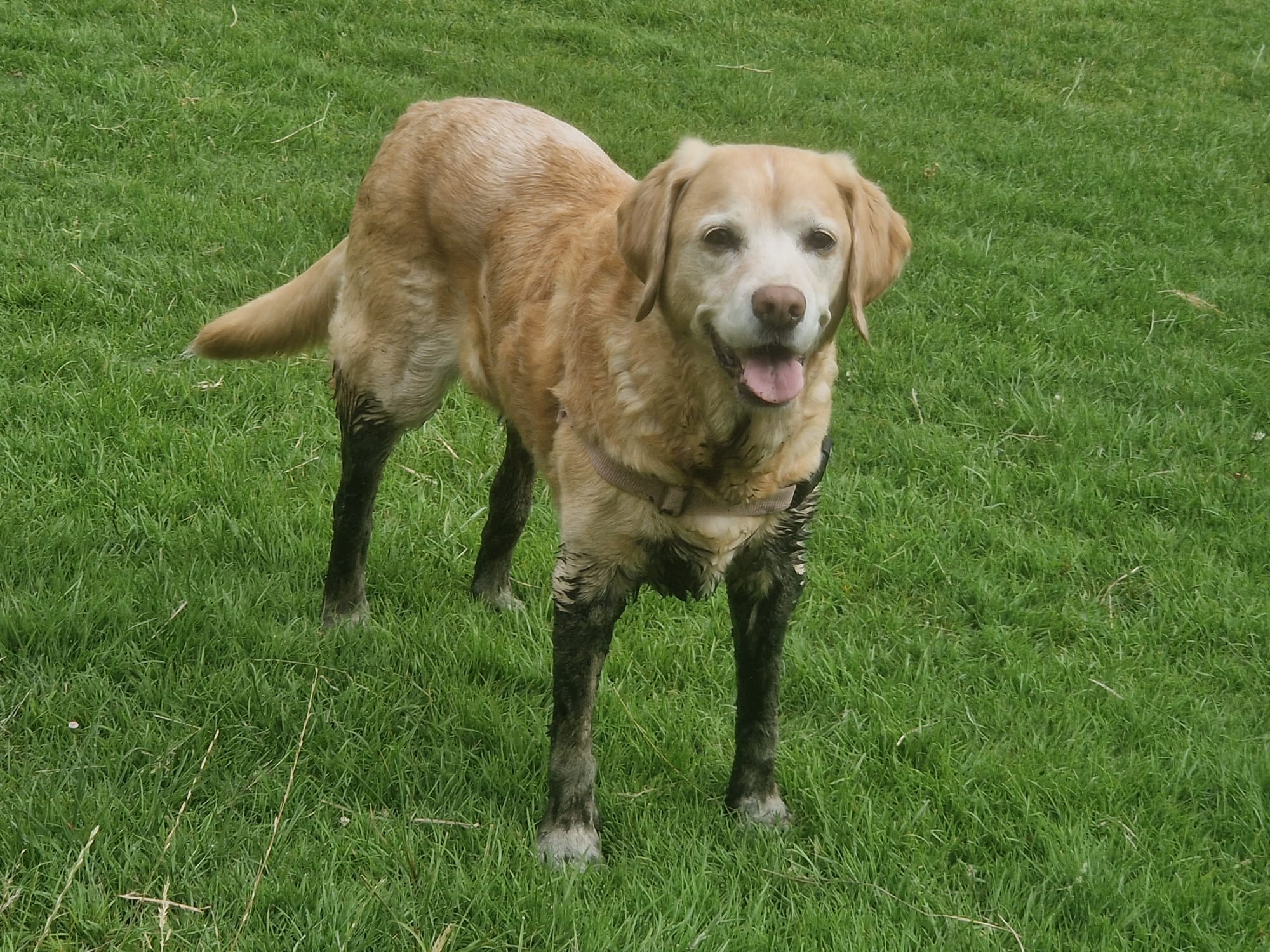
Other dogs dislike wet or boggy ground.
Again, I adapt.
I may choose:
- a better-drained route
- wider paths
- more pavement
- a shorter walk
- somewhere less slippery
I also think about the dog.
A young, steady dog may cope well on a muddy route.
An older dog who is already stiff may not need a slippery woodland path.
A large dog pulling downhill through mud can also create a risk for the person holding the lead.
Sometimes the boring route is the sensible route.
Walking dogs in cold weather
Cold weather needs the same individual approach as hot weather.
I do not use one temperature cut-off for every dog.
A fit dog with a thick coat may enjoy a cold walk.
A small, older or short-haired dog may feel uncomfortable much sooner.
PDSA says most dogs will be fine for short periods in the cold without additional layers, but some dogs need extra warmth, including dogs with fine or thin fur and dogs who are very young, underweight, older or unwell.
My main questions are:
Is the dog comfortable?
Are they moving normally?
Are they reluctant to continue?
Are they shivering?
Are they repeatedly lifting their paws?
Has their normal behaviour changed?
I do not insist on completing a route because another dog of the same breed appears fine.
Dog coats are useful for some dogs
I am not interested in dressing a dog up for Instagram.
But suitable clothing can help dogs who genuinely struggle with cold or wet conditions.
Some short-haired dogs.
Older dogs.
Underweight dogs.
Dogs who are unwell.
Dogs who become cold quickly.
They may benefit from a properly fitted coat.
The dog also has to be comfortable wearing it.
Do not wrestle a frightened dog into clothing they have never seen five minutes before their walk.
Introduce new equipment calmly.
Check the fit.
And make sure the dog can move freely.
For my own professional walks, I only use coats, boots, paw balms or similar products supplied or approved by the owner.
Snow can be fun, but ice changes everything
Some dogs absolutely love snow.
They run.
Sniff.
Roll.
And look delighted with life.
But snow can hide hazards.
Ice creates another problem.
Slippery pavements can be dangerous for dogs and people.
This matters even more if your dog pulls or suddenly changes direction.
Older dogs and dogs with mobility problems may also find slippery surfaces difficult.
PDSA warns that dogs can slip and fall on icy surfaces and advises extra care, particularly for dogs with problems such as arthritis.
You can read PDSA winter pet care advice.
I also avoid frozen ponds.
A dog does not understand whether the ice will hold their weight.
Read my guide to dogs and frozen ponds.
If conditions are unsafe for me to walk safely while holding your dog’s lead, the normal walk may need to change.
Salt, grit and winter paws
Road salt and grit can irritate paws.
Snow and ice can also build up around some dogs’ feet.
After a winter walk, check your dog’s paws.
Depending on the conditions, rinse or wipe them and dry between the toes.
Do not forget the legs and belly if your dog has walked through dirty roadside slush.
My guide to walking dogs in wintry weather covers winter walks in more detail.
You can also read protecting your dog’s paws in snow and ice.
A simple towel by the door makes life much easier.
Sometimes the basic dog-walking kit is the most useful.
Does bad weather mean my dog does not get exercise?
No.
It means the plan may change.
I think we sometimes become too focused on distance.
Thirty minutes must mean thirty minutes walking.
An hour must mean a long route.
The dog must come home tired.
I do not agree.
A shorter sniff walk may be more suitable.
A brief outdoor trip followed by calm enrichment may be better.
You could use:
- Find It
- scatter feeding
- a cardboard search box
- a Kong
- a lick mat
- simple training
- scent games
My guide to how to tire a dog out without a long walk gives you practical ideas.
You can also read why I think dog walks should be for dogs, not our step targets.
A missed long walk is not a reason to spend an hour firing a ball across the living room.
Keep things calm.
How I decide whether to change a professional dog walk
Before and during a walk, I consider:
- your dog’s age, health and mobility
- their individual needs
- their normal tolerance
- the planned activity
- the local weather
- the ground conditions
- shade and shelter
- water
- official weather warnings
- the route
- whether I can safely access your property
- risks to your dog, the public and me
A weather warning does not automatically cancel every service.
A normal walk may be unsuitable while a home visit is still perfectly manageable.
Conditions can also change locally.
That is why my Extreme Weather Policy allows me to change the time, route, length or type of activity where I believe this is necessary for safety or welfare.
Where practical, I will contact affected clients and explain the change.
I am not going to quietly march your dog around the block in unsafe conditions so the booking looks completed.
Your dog’s welfare comes first.
What dog owners can do to help
A few simple things make adapting walks much easier.
Tell me if your dog:
- has struggled in heat before
- feels the cold
- uses a coat
- has mobility problems
- has developed a new health problem
- has changed medication
- has started behaving differently on walks
During warmer weather, make sure water is available at home.
During wet weather, leave a towel somewhere accessible.
If your dog uses a particular coat, show me how you normally fit it.
And please tell me when something changes.
A dog I walked six months ago may not have exactly the same needs today.
Dogs get older.
Health changes.
Mobility changes.
Confidence changes.
Good dog care has to change with them.
Why one-to-one walks make weather changes easier
This is one of the reasons I continue to provide solo dog walks.
There is no van collection.
No group of dogs waiting.
No pressure to complete one route for everyone.
I collect your dog from home and walk locally on foot.
If your dog needs to slow down, we slow down.
If your dog needs more shade, I change the route.
If an older dog needs a shorter walk, I do not need to make them keep up with five younger dogs.
And if weather means the normal plan is unsuitable, I can focus on the individual dog in front of me.
Read more about my solo dog walks in Finchley and Muswell Hill.
You can also read solo dog walks versus group walks if you are trying to decide which type of service would suit your dog.
The forecast does not know your dog
I check the weather.
I pay attention to official warnings.
I assess the route.
But I never forget the dog.
My old collie would happily have carried on in conditions that another dog found miserable.
That did not make one dog better.
They were different.
That is the important point.
Do not force your dog through a normal walk because:
“They always have an hour.”
“The weather app says it is only 20°C.”
“My friend’s Labrador is fine.”
“They need their steps.”
Look at your dog.
Are they comfortable?
Are they moving normally?
Are they showing you they want to continue?
Has something changed?
Sometimes the best dog walk is shorter than planned.
Sometimes it is slower.
Sometimes it happens on another route.
And sometimes you put the lead away and do something calm at home.
That is not being lazy.
It is knowing the dog in front of you.
For hot-weather advice, start with my Summer Dog Safety Guide.
For the specific temperature question, read How Hot Is Too Hot to Walk Your Dog?
For practical summer equipment, see my Hot Weather Dog Kit.
And if you are a Finchley Dog Walker client, my Extreme Weather Policy explains how I may adapt booked care when conditions are unsuitable.
Frequently asked questions
Should I walk my dog in bad weather?
It depends on the weather and your individual dog.
Moderate rain may be manageable for one dog while another becomes cold or distressed.
Severe wind, thunderstorms, extreme heat and dangerous ice may mean the normal walk needs to be shortened, adapted or skipped.
How hot is too hot to walk a dog?
There is no single temperature that is safe for every dog.
Age, health, breed or type, weight, coat, fitness, humidity, direct sunlight, surfaces and exercise intensity all matter.
Read my full guide to how hot is too hot to walk your dog.
Is rain bad for dogs?
Rain does not automatically mean a dog cannot walk.
Consider how cold and wet your dog is becoming, the wind, visibility, flooding and how your dog feels about the conditions.
Dry your dog properly after a wet walk.
Should I walk my dog during a thunderstorm?
I would avoid a normal dog walk during a thunderstorm.
The Met Office advises staying indoors where possible and seeking safe enclosed shelter if caught outside.
Dogs who are frightened by thunder may also be more likely to panic or try to bolt.
Can dogs walk in strong winds?
Mild wind may cause no problem.
Strong winds can bring falling branches, flying debris and sudden noises or movement that unsettle dogs.
Follow official weather warnings and adapt or postpone the walk where conditions are unsafe.
How cold is too cold to walk a dog?
There is no universal temperature for every dog.
Consider your dog’s size, age, health, coat and normal tolerance.
Short-haired, very young, older, underweight and unwell dogs may feel the cold more quickly.
Should I wash my dog’s paws after walking on gritted roads?
Check your dog’s paws after winter walks.
Salt and grit can irritate paw pads.
Wipe or rinse paws where necessary and dry them carefully, including between the toes.
What can I do if the weather stops a normal dog walk?
Try a shorter toilet and sniffing trip followed by calm enrichment.
Scent games, scatter feeding, a Kong, a lick mat or simple training can provide mental stimulation without trying to recreate a long walk indoors.
Disclaimer
This article provides general dog-care information based on my professional pet-care experience and publicly available animal-welfare guidance. It does not replace veterinary advice or diagnosis. Every dog’s health and ability to cope with weather conditions is different. If your dog has a medical condition, breathing difficulty, mobility problem or has previously struggled in hot or cold weather, speak to your vet about their individual needs. Heatstroke is an emergency. If you think your dog is overheating, start cooling them and contact a vet urgently.


