Updated July 2026
I sometimes wonder who the dog walk is actually for.
The dog?
Or the step counter on your wrist?
You have thirty minutes before work.
Your watch wants a certain pace.
You want to complete the usual route.
Your dog stops at a lamppost.
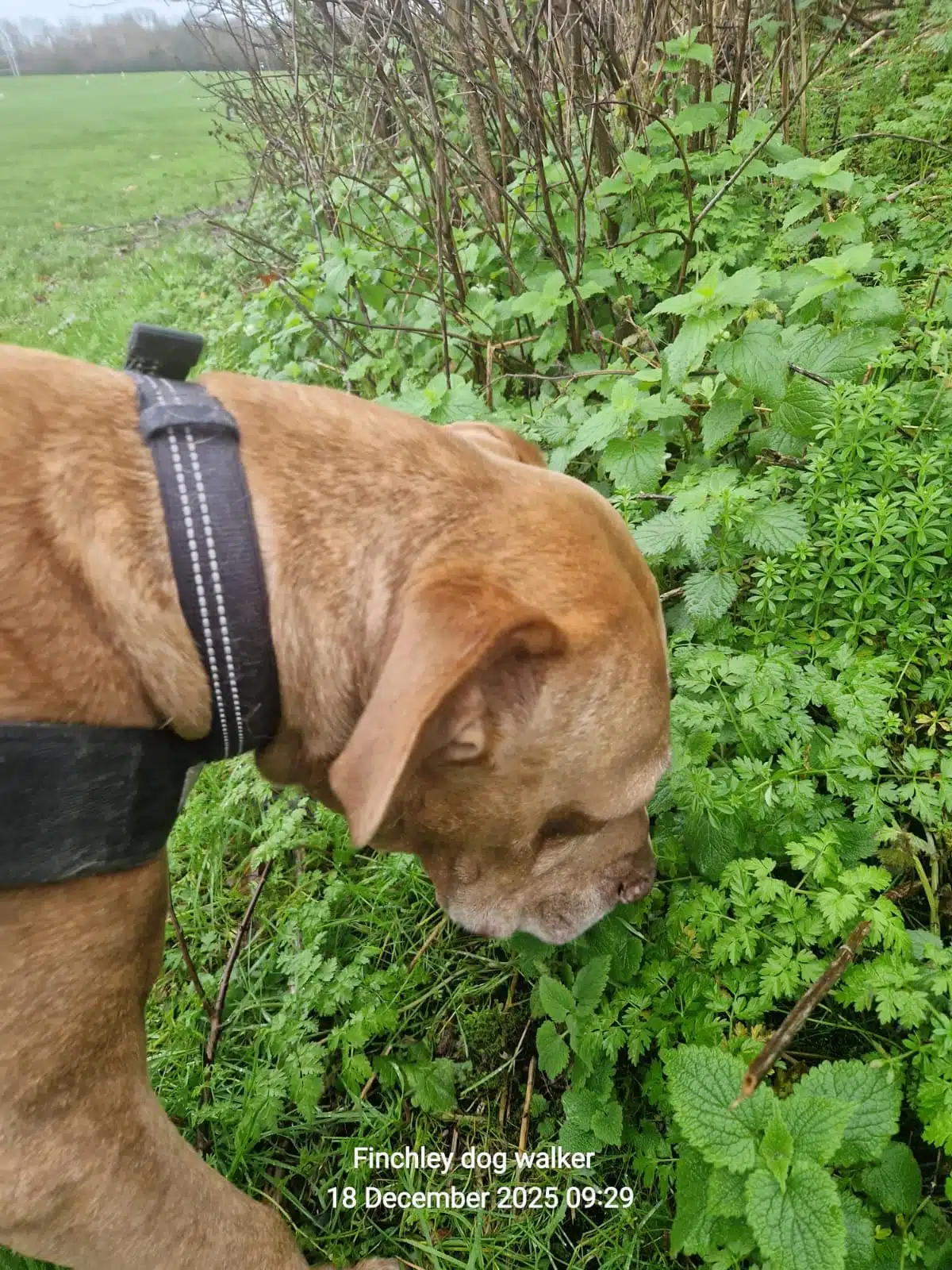
They sniff.
And sniff.
You say, “Come on.”
The lead tightens.
Off you go.
Two minutes later, they stop again.
Another smell.
Another delay.
But your dog was not wasting the walk.
They were using it.
I have walked dogs professionally since 2011.
And I do not measure a successful dog walk by how far we travelled.
Some dogs cover plenty of ground.
Others stop every few metres.
A senior dog may need a slower pace.
A nervous rescue dog may spend time watching and sniffing before they feel ready to move.
Another dog may spend five minutes investigating one hedge.
I am fine with that.
Your dog’s booked walk is about your dog.
I do not have five other dogs waiting for them to keep up.
And I am certainly not worried about closing the rings on my fitness watch.
Some links on this page may be affiliate links. If you buy through them, I may earn a small commission at no extra cost to you. I only recommend products that fit the practical advice on this page.
Your dog is not tracking their pace
We are obsessed with measuring things.
Steps.
Miles.
Minutes per kilometre.
Calories.
Heart rate.
I am not against fitness watches.
I use technology myself.
But your dog’s walk should not become another human exercise target.
Imagine going somewhere interesting.
You stop to look at something.
The person with you immediately pulls you away.
You try to stop somewhere else.
Pulled away again.
Keep moving.
Keep up.
We have a route to finish.
That is how some dogs spend their walks.
The dog stops to sniff.
“Come on.”
They look towards something.
“This way.”
They slow down.
The lead tightens.
We become so focused on keeping our pace that we forget to look at the dog.
I wrote about this in my guide to how weather affects dog walks.
Sometimes the route needs to change.
Sometimes the pace needs to change.
And sometimes your dog needs us to stop chasing distance.
Sniffing is not wasting the walk
PDSA describes a slow, meandering walk where a dog can sniff and explore as beneficial for their mental health. You can read the PDSA advice on exercise for dogs.
That does not mean physical exercise suddenly stops mattering.
It matters.
Dogs need suitable exercise based on their age, health and individual needs. But walking is not simply about moving a body from point A to point B.
Dogs experience a huge amount of their environment through smell.
When your dog stops at a lamppost, hedge or patch of grass, they are checking the wee-mail and are investigating.
Other dogs have been there.
Wildlife may have passed through.
People have walked past.
The environment has changed since yesterday.
I sometimes jokingly call it reading the wee-mail.
Your dog may have walked the same street in North Finchley hundreds of times.
That does not mean it smells exactly the same to them today.
So when your dog stops to sniff, I do not automatically see it as a waste of time.
I see a dog using one of their most important senses.
My guide to The Sniff and Decompress Walk for Dogs looks more closely at slower decompression-style walks.
What does your dog actually learn by sniffing?
I am always careful with this question.
You will see some fantastic claims online about exactly what a dog knows from a single sniff.
The dog’s age.
Sex.
Health.
Mood.
What they had for breakfast.
Their mother’s maiden name.
Social media sometimes gets carried away.
But scent is an important part of canine communication and exploration.
Dogs investigate scent left by other animals.
They notice changes in their environment.
They investigate where people and animals have moved.
They can spend far longer investigating one small area than we expect.
The important thing for me is simple.
Your dog is interested.
They are actively investigating their environment.
That is enough reason for me to give them some time.
I do not need to invent a magical story about exactly what they are thinking.
Watch your dog.
You can often see when they have found a particularly interesting scent.
Their pace changes.
Their nose drops.
They may move backwards.
Check the same area again.
Follow the scent for a few metres.
That is your dog doing something they clearly find important.
Does sniffing really tire dogs out?
You may have seen this claim:
“Twenty minutes of sniffing is the same as an hour’s walk.”
Or:
“Ten minutes of sniffing equals thirty minutes of exercise.”
These claims get shared repeatedly.
I would not repeat either as scientific fact.
Dogs are not calculators.
Twenty minutes of sniffing does not magically equal sixty minutes walking.
I cannot find reliable research that proves an exact time conversion.
The 2025 scientific review, The Value of Sniffing: A Scoping Review of Scent Activities for Dogs, examined 27 studies on scent-based activities.
The researchers found growing interest in how scent activities may affect dogs.
But the review also highlights that this is still a developing area of research.
So yes.
Sniffing and scent-based activities can give dogs something to think about.
Many owners also notice their dogs settle differently after a slower, scent-focused activity.
But I am not going to tell you that 17 minutes of sniffing equals 43 minutes of jogging.
That is not how dogs work.
Instead, ask yourself:
Did my dog have a chance to explore?
Did they use their nose?
Did they make some safe choices?
Did the walk suit the dog in front of me?
That tells me far more than a viral graphic.
Why choice matters on a dog walk
A 2019 study by Charlotte Duranton and Alexandra Horowitz compared pet dogs participating in regular nosework with dogs performing heelwork.
The nosework group showed a more positive judgement bias after the activity programme.
The researchers discussed nosework as an opportunity for dogs to express natural behaviour and have more autonomy.
You can read the original research paper Let Me Sniff! Nosework Induces Positive Judgment Bias in Pet Dogs.
But I want to be accurate here.
The study involved regular nosework activities.
It did not prove that letting your dog sniff one lamppost for thirty seconds will transform their emotional wellbeing.
Still, I think the idea of appropriate choice matters.
On my walks, that may mean allowing a dog to choose which side of a path they investigate.
Stopping when they find an interesting scent.
Following their nose a short distance where it is safe.
Turning into a quieter route when there is no reason not to.
I am still responsible for the walk.
I choose what is safe.
The dog does not get to drag me into the North Circular because there is an interesting smell on the other side.
But a dog walk does not have to involve me controlling every single second.
Sometimes I follow the dog.
A sniff walk does not mean your dog does whatever they want
This is important.
Giving your dog time to sniff does not mean:
- being pulled into the road
- disappearing into bushes on a long line
- eating rubbish
- chasing wildlife
- approaching every dog
- ignoring other people
- wrapping the lead around a cyclist
- spending forty minutes refusing to leave someone’s front garden
I still use boundaries.
I still manage the lead.
I still move dogs away from hazards.
I still say, “Let’s go,” when we need to move.
The difference is that I do not rush a dog simply because sniffing slows my pace.
A good sniff walk needs balance.
Your dog gets opportunities to investigate.
You remain responsible for safety.
That is one reason appropriate equipment matters.
For some dogs and suitable locations, a long line for sniff walks can provide more freedom to explore while the dog remains attached.
I prefer to use a long line with a suitable, well-fitted harness.
I do not attach a long line to a dog’s neck and let them hit the end at speed.
My guide to the pros and cons of dog harnesses and collars covers equipment in more detail.
Why I use sniff walks with some rescue and nervous dogs
Rescue dogs are a big part of why Finchley Dog Walker exists.
My rescue dog Roxy was awkward but awesome.
And she taught me a lot.
When a dog is nervous, we often become obsessed with getting them to move forward.
Come on.
Let’s go.
You’ll be fine.
Keep walking.
But sometimes the dog needs time to look.
Smell.
Listen.
Process.
I work with rescue and nervous dogs who may initially find their local environment difficult.
A bin has moved.
Someone is unloading a van.
A dog is barking behind a gate.
There are builders further down the road.
Everything matters to that dog.
I am not saying sniffing fixes fear or reactivity.
It does not.
A dog with significant behavioural concerns may need help from an appropriately qualified behaviour professional and their vet.
But on suitable walks, giving a dog time to investigate can be part of a calmer, less rushed approach.
I talk more about this in my guide to The Sniff and Decompress Walk for Dogs.
You can also read about my Rescue Dog Support in Finchley.
Sniffing is not automatically calming
This might surprise you.
People often say:
“Sniffing calms dogs.”
Sometimes it appears to help a dog settle and explore.
But I look at the whole dog.
A dog can sniff and become more aroused.
They may pick up another dog’s scent and start tracking it urgently.
Their movement becomes faster.
Their body becomes tense.
They stop responding to you.
They scan the environment.
That does not look like a relaxed dog enjoying a gentle sniff.
Another dog may become obsessed with searching for food.
Some dogs try to eat absolutely everything they investigate.
And a reactive dog may smell or notice something that increases their vigilance.
Do not look at one behaviour in isolation.
Look at the dog.
Are they loose and comfortable?
Are they able to move away?
Can they respond to you?
Is their pace becoming frantic?
Has their body language changed?
Sniffing is an activity.
It is not a magical off switch.
My article on how to walk an anxious dog without making it worse explains why watching the individual dog matters.
Why older dogs may need us to stop chasing distance
This is one I feel strongly about.
Your dog walked for an hour when they were five.
They are now twelve.
But we still expect the same route.
The same hills.
The same speed.
The same recovery.
Dogs get older.
Arthritis can develop.
Gait can change.
Health changes.
Recovery may take longer.
Your dog cannot say:
“My hips are a bit stiff today. Can we do twenty minutes and have a good sniff instead?”
They show you.
They slow down.
Stop.
Hesitate.
Lag behind.
Change the way they move.
Sometimes all the owner feels is resistance on the lead.
Especially when they are focused on keeping pace.
I do not think older dogs should automatically stop walking.
Far from it.
But the walk may need to change.
A slower sniff walk can allow some older dogs to continue getting outside without chasing the distance they managed years ago.
Read my guide to senior dog exercise and enrichment.
And please speak to your vet if your dog’s movement, exercise tolerance or normal behaviour changes.
Do not assume slowing down is simply old age.
Sniff walks during hot weather
This article fits naturally into my summer dog safety advice.
But I need to make one thing very clear.
A sniff walk does not make dangerous heat safe.
Please do not read this article and think:
“Del says sniff walks are good, so we can go out at midday as long as we walk slowly.”
No.
If conditions are unsafe for your dog, change the plan.
Skip the walk where necessary.
My guide to how hot is too hot to walk your dog explains how I assess temperature, humidity, surfaces, the individual dog and exercise intensity.
You should also read my Summer Dog Safety Guide.
But when conditions are suitable, changing the type of walk can sometimes make sense.
Instead of:
- marching around a long route
- ball throwing
- running
- chasing distance
I may choose:
- a shorter route
- more shade
- a slower pace
- more sniffing
- more time to stop
- less intense activity
That is not a heatstroke prevention formula.
It is simply one way I adapt suitable walks as conditions change.
And when a normal walk is not safe, my guide to what to do instead of walking your dog in a heatwave offers calmer indoor options.
How to take your dog on a sniff walk
You do not need a course.
You do not need to drive to the countryside.
And you do not need expensive equipment.
Start with your normal walk.
Leave the fitness target at home
Stop worrying about your pace.
You can go for your own fitness walk later.
This one is for the dog.
Choose a suitable route
You want somewhere your dog can safely investigate.
For some dogs, that may be woodland.
For others, a quiet local street is enough.
I use places such as Cherry Tree Wood, Coldfall Woods and Highgate Woods when they suit the individual dog.
But I do not automatically take every dog into woodland.
My guide to choosing where to walk dogs in Finchley explains why the dog decides the route.
Slow down
This sounds obvious.
But actually slow down.
Notice how often you normally say:
“Come on.”
You may surprise yourself.
Let your dog investigate
Your dog stops.
You stop.
Give them a little time.
You do not need to stand there for the rest of the afternoon.
But resist the urge to pull them away immediately.
Watch the whole dog
Are they calmly investigating?
Or becoming increasingly tense or frantic?
Body language matters.
Move on when needed
Sniffing does not remove boundaries.
Use your normal cue and move on calmly.
Let the route breathe a little
Where it is safe, give your dog some choice.
Left or right?
This path or that one?
Which side of the grass?
Not every decision needs to be yours.
A treat pouch is probably one of my most-used bits of walking kit
I do not need much equipment for a sniff walk.
But I do like having rewards easily available.
There is nothing worse than seeing the exact behaviour you want to reward, only to spend 30 seconds digging around in your coat pocket.
By then the moment has gone.
A simple dog walking treat pouch keep small rewards easy to reach.
I use treats for things such as:
- rewarding check-ins
- Find It
- reinforcing calm choices
- moving away from something
- simple training moments
I am not constantly feeding a dog simply for existing.
And food is not suitable for every dog or every situation.
But for dogs who can have treats, easy access makes reward-based handling much simpler.
Keep the treats small.
Consider using part of your dog’s normal food where appropriate.
And remember to include treats in their overall daily food intake.
Five simple scent activities you can try at home
Sometimes you cannot manage a long walk.
The weather may be too hot.
Your dog may need a quieter day.
Or you may simply want to give them another opportunity to use their nose.
You do not need to turn your home into a professional scentwork centre.
Keep it simple.
Find It
Take a small piece of food.
Let your dog know you have it.
Toss it a short distance and say, “Find it.”
Start easy.
Once your dog understands the game, you can gradually make the search a little harder.
Scatter feeding
Use part of your dog’s normal food.
Scatter it safely across suitable grass, a snuffle mat or another safe area.
Let them search.
Read my Ditch the Bowl at Mealtimes guide for more simple feeding ideas.
Cardboard box search
Place a few treats or pieces of food in or around cardboard boxes.
Make the first game ridiculously easy.
Your dog needs to learn that searching works.
Always supervise.
Remove staples, tape and anything unsafe.
And do not use this activity for a dog who simply eats cardboard.
My guide to dog enrichment ideas that actually help calm and tire your dog has more ideas.
Hide food around a room
Ask your dog to wait elsewhere if they can do so comfortably.
Hide a few small pieces of food in easy locations.
Let them search.
Again, start easy.
I want the dog to understand the game.
Not file a formal complaint because I have hidden one piece of kibble behind the boiler.
Use a food toy
For dogs who enjoy them, a Kong, snuffle mat or suitable food toy can provide a simple searching or problem-solving activity.
My Hot Weather Dog Kit includes the enrichment products I use or recommend during warmer weather.
You can also read my complete guide to Kong toys for dogs.
Sniff walks are not a replacement for every other type of exercise
I can already hear someone saying:
“So dogs don’t need physical exercise anymore?”
That is not what I am saying.
Dogs still need appropriate physical activity.
The amount and type depend on the dog.
Some dogs enjoy a brisk walk.
Some enjoy running where it is safe and suitable.
Some love play.
Some need a mixture of physical activity, sniffing, training and rest.
A sniff walk is another type of walk.
It does not have to replace everything else.
PDSA’s own exercise advice makes the distinction.
A brisk walk can provide physical exercise.
A slower, meandering walk gives a dog opportunities to sniff and explore.
You do not have to choose one type forever.
Look at your dog.
What do they need today?
Should I let my dog choose the route?
Sometimes.
Within reason.
I occasionally let a dog influence which way we go.
It can be interesting.
One path.
Another path.
Across the grass.
Back towards home.
But I am still responsible for safety.
I may say no because:
- the pavement is too hot
- another dog is ahead
- the route is too busy
- we are approaching livestock or wildlife
- the dog is becoming overwhelmed
- the path is unsafe
- we need to return home
Choice does not mean complete control.
Think of it as giving your dog a voice in the walk.
You still make the final safety decision.
Why one-to-one walks make this easier
This is one reason I continue to offer solo dog walks.
I work with one household at a time.
No vans.
No group of dogs.
No pressure for your dog to keep up with five others.
If your dog wants to sniff, we can slow down.
If your senior dog is stiff, I can adapt.
If your nervous rescue dog needs space, I can choose another route.
If the weather changes, the walk changes.
Your dog does not have to fit into the group’s plan.
The walk is planned around the dog in front of me.
You can read more about my solo one-to-one dog walks in Finchley and Muswell Hill.
My guide to calm one-to-one enrichment walks also explains how I build sniffing, searching and simple choices into walks.
How I judge a good dog walk
I do not come home and immediately check how many kilometres I covered.
I think about the dog.
Did they cope with the environment?
Did they have opportunities to sniff?
Did I notice any changes in their movement?
Did their behaviour change?
Did they get some choice where it was safe?
Did they respond differently to something today?
Did they return home comfortable?
That tells me far more than my step count.
Some of my walks cover a good distance.
Others do not.
And sometimes a dog spends so long reading the wee-mail that I am fairly sure they have gone through the entire local inbox.
That is fine.
Walk the dog you have.
Not the dog you had five years ago.
Not your friend’s dog.
Not the Labrador running around the field.
And definitely not the dog your fitness watch thinks you should have.
Your dog’s walk should be for your dog.
Give them time to sniff.
Frequently asked questions
Is sniffing good for dogs?
Sniffing is a natural way for dogs to investigate their environment.
PDSA describes slow walks with opportunities to sniff and explore as beneficial for dogs’ mental health.
Do sniff walks tire dogs out?
Scent activities give dogs opportunities to investigate and use their nose.
Many owners report their dogs settle well after sniffing activities.
However, I would not use a fixed formula that claims a certain number of minutes of sniffing equals a specific amount of physical exercise.
Is twenty minutes of sniffing equal to an hour’s walk?
I cannot find good scientific evidence proving this exact conversion.
Dogs are individuals and different activities meet different needs.
Twenty minutes of sniffing does not magically equal an hour’s walk.
Should I let my dog sniff everything?
No.
Move your dog away from unsafe substances, rubbish, toxic plants, faeces or anything else that creates a risk.
You are still responsible for managing the walk.
Why does my dog sniff the same place for so long?
Your dog may have found a particularly interesting scent.
Other animals, dogs or people may have passed through the area.
You do not need to know exactly what your dog has detected to recognise that they are interested in investigating it.
Are sniff walks good for reactive dogs?
Some reactive dogs may enjoy quieter walks with opportunities to sniff and explore.
But sniffing does not treat reactivity, and it is not automatically calming.
Watch your dog’s body language and seek appropriately qualified professional support where needed.
Are sniff walks good for senior dogs?
They can suit some senior dogs because the pace can be adapted and the focus does not have to be on covering long distances.
Speak to your vet if your older dog’s movement, behaviour or exercise tolerance changes.
How long should a sniff walk be?
There is no fixed time.
Base the walk on your dog’s age, health, fitness and individual needs.
The quality of the walk matters more to me than achieving an arbitrary distance.
Can a sniff walk replace exercise?
Sniff walks are one type of activity.
Most dogs need a suitable balance of physical exercise, opportunities to explore, mental activity and rest.
Your vet can advise you whether your dog has a health condition that affects exercise.
Should I let my dog choose the route?
You can allow appropriate choice where it is safe.
You remain responsible for avoiding hazards, managing other dogs and people, and getting your dog home safely.
Disclaimer
This article provides general information on dog care and walking, based on my professional experience and publicly available animal welfare research and guidance. It does not replace veterinary advice, diagnosis or individual behavioural assessment. Every dog is different. If your dog’s movement, exercise tolerance or behaviour changes, speak to your vet. Dogs with significant fear, anxiety or behavioural concerns may also need support from an appropriately qualified reward-based behaviour professional.
You may also like to read my guide on enrichment ideas to make walks more interesting , stress-free dog walking, and how much exercise does a dog need